
2026 Lasker Awards Honor Breakthroughs in Sleep, Hemophilia and Parkinson’s Research
The 2026 Lasker Awards highlight three very different ways medical progress can change lives: understanding how the brain controls wakefulness, finding a smarter way to treat hemophilia A, and turning patient advocacy into a powerful force for Parkinson’s research.
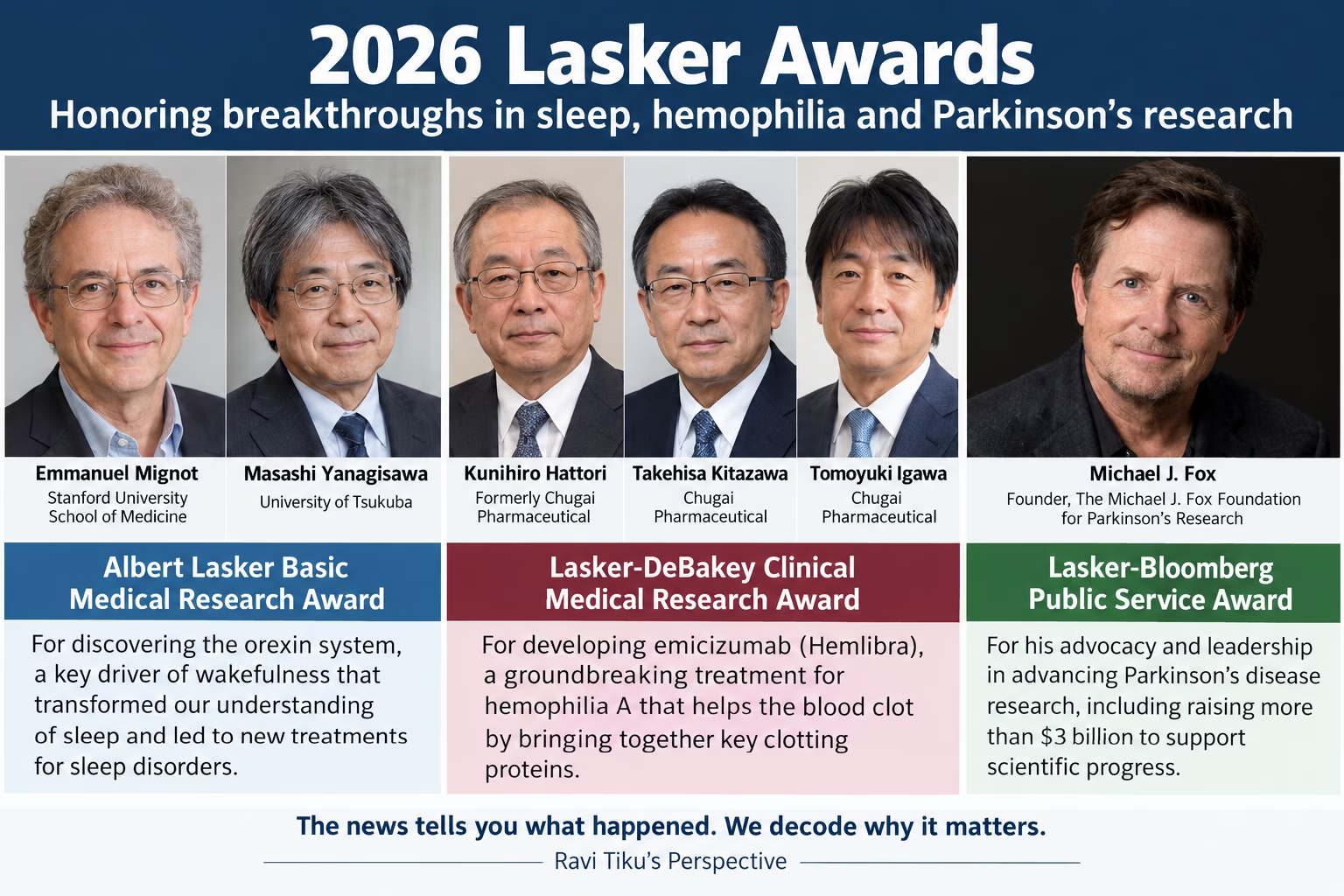
Often described as “America’s Nobel Prizes,” the Lasker Awards recognize discoveries and contributions that have had a major impact on biomedical science and public health. This year’s winners include sleep researchers Emmanuel Mignot and Masashi Yanagisawa, hemophilia researchers Kunihiro Hattori, Takehisa Kitazawa and Tomoyuki Igawa, and actor and Parkinson’s advocate Michael J. Fox.
The awards are more than recognition. Their stories show how basic scientific discoveries can eventually become treatments — and how patients and advocates can influence the direction of medical research.
What Happened?
The Lasker Foundation announced its 2026 award winners on September 9.
Three awards were presented:
- Albert Lasker Basic Medical Research Award: Emmanuel Mignot and Masashi Yanagisawa for discoveries that transformed understanding of the brain’s sleep-wake system.
- Lasker-DeBakey Clinical Medical Research Award: Kunihiro Hattori, Takehisa Kitazawa and Tomoyuki Igawa for developing emicizumab, a major treatment for hemophilia A.
- Lasker-Bloomberg Public Service Award: Michael J. Fox for his long-running advocacy and support for Parkinson’s disease research.
Each award carries a $250,000 honorarium. The awards will be presented in New York City on September 17.
Why the Sleep Discovery Matters
Sleep can seem like a simple part of everyday life. Biologically, however, it is an extraordinarily complex process.
The work recognized by the Lasker Foundation helped identify orexins, brain signaling molecules that play a central role in maintaining wakefulness.
Masashi Yanagisawa and his colleagues were studying G protein-coupled receptors whose activating chemicals were unknown. Their experiments eventually identified two related peptides that they named orexins.
The researchers initially suspected that orexins might be connected to appetite because they were produced in the hypothalamus, a brain region involved in eating behavior.
Further research revealed something much more important.
Orexins help keep the brain awake.
Meanwhile, Emmanuel Mignot was investigating narcolepsy, a neurological disorder characterized by excessive daytime sleepiness. His research connected orexin deficiency with narcolepsy.
The two research paths ultimately converged on the same biological system.
That was a major change in sleep science.
Instead of looking only at which parts of the brain were involved in sleep, scientists could begin examining the molecular and genetic mechanisms controlling wakefulness and sleep.
From a Laboratory Discovery to New Medicines
This is perhaps the most important lesson from the sleep research.
A fundamental discovery can take years to become useful medicine.
Understanding the orexin system eventually helped scientists develop two different therapeutic approaches.
Orexin receptor antagonists reduce wakefulness and can be used to promote sleep in people with insomnia.
The opposite strategy is also possible.
Orexin receptor agonists stimulate the wakefulness system and are being developed to help people with narcolepsy.
This illustrates why basic research matters even when there is no immediate treatment at the beginning.
Scientists were initially trying to understand biology. Years later, that knowledge became the foundation for medicines.
Hemophilia Treatment Takes a Different Approach
The clinical research award recognizes another striking example of scientific problem-solving.
Hemophilia A is an inherited bleeding disorder caused by insufficient or absent clotting factor VIII.
Factor VIII normally works with other clotting proteins to help the blood form a stable clot. When the process fails, bleeding can become prolonged and, in severe cases, occur without obvious injury.
Repeated bleeding into joints can also cause pain and long-term damage.
The researchers behind emicizumab approached the problem differently.
Instead of simply replacing factor VIII, they designed an antibody capable of bringing two other clotting proteins — factors IX and X — together.
In effect, the medicine helps recreate an important function normally performed by factor VIII.
The resulting drug, emicizumab, is marketed as Hemlibra. The U.S. Food and Drug Administration approved it in 2017, and it has subsequently been approved in many other countries.
According to the Lasker Foundation, more than 30,000 people have received the treatment.
Why Emicizumab Is Important
The significance of emicizumab goes beyond one drug.
It demonstrates an important principle in modern medicine: a disease does not always have to be treated by replacing the missing component directly.
Researchers can sometimes find another biological route to achieve the same result.
That kind of thinking can open new possibilities for other inherited and complex diseases.
For people living with hemophilia A, however, the significance is much more immediate.
Better control of bleeding can mean fewer medical emergencies and potentially less damage from repeated bleeding episodes.
Michael J. Fox and the Power of Patient Advocacy
The third Lasker award tells a different story.
Michael J. Fox was diagnosed with early-onset Parkinson’s disease in 1990, when he was only 29. He publicly disclosed his diagnosis in 1998.
His visibility brought enormous public attention to Parkinson’s disease.
But Fox did more than raise awareness.
Through the Michael J. Fox Foundation for Parkinson’s Research, he helped build a major funding and advocacy organization focused on accelerating Parkinson’s research.
According to the Lasker Foundation, the organization has funded more than $3 billion in Parkinson’s research since 2000.
That makes Fox’s recognition particularly significant.
Scientific progress does not happen only inside laboratories. Funding, advocacy, patient participation and public awareness can all influence which questions researchers are able to pursue.
The Bigger Picture: Three Different Paths to Medical Progress
The 2026 Lasker Awards bring together three very different stories.
| Award focus | What changed? | Broader significance |
| Sleep research | Scientists identified the orexin system’s role in wakefulness | Created new directions for treating sleep disorders |
| Hemophilia A | Researchers found a way to mimic an essential clotting function | Demonstrated an alternative strategy for treating inherited disease |
| Parkinson’s advocacy | Patient advocacy generated substantial research support | Shows how public engagement can accelerate medical research |
The common thread is not a particular disease.
It is translation.
A biological discovery becomes a treatment. A treatment changes patient care. Advocacy generates funding. Funding enables more research.
Medical progress is often a chain rather than a single breakthrough.
What This Could Mean for Patients
For patients, the awards offer reason for optimism, but they should not be interpreted as promises of immediate cures.
The sleep discoveries have already contributed to new treatments for insomnia and narcolepsy. The hemophilia work has produced an established therapy used internationally.
Parkinson’s disease remains a major challenge, and advocacy has not yet produced a cure.
That distinction matters.
Recognition from a prestigious scientific organization does not mean a disease has been solved. It means the underlying work has been judged to have made an important contribution to science, medicine or public health.
What Happens Next?
The next stage will involve extending these discoveries and finding better ways to use them.
For sleep disorders, researchers will continue exploring how the orexin system can be targeted safely and effectively.
For hemophilia, researchers will continue improving treatment options and understanding how different therapies can best be used for individual patients.
For Parkinson’s disease, research remains focused on understanding the disease, detecting it earlier, developing better treatments and ultimately finding ways to slow, stop or prevent its progression.
The important point is that today’s award-winning discoveries can become the starting point for tomorrow’s research.
Ravi Tiku’s Perspective
The most interesting part of the 2026 Lasker Awards is not the celebrity recognition or the prestige attached to the prizes.
It is the connection between curiosity, persistence and practical medicine.
The sleep researchers were not initially searching for a sleeping pill. They were trying to understand a biological mystery.
The hemophilia researchers did not simply accept the conventional approach of replacing a missing clotting factor. They asked whether the same biological outcome could be achieved differently.
And Michael J. Fox demonstrated that patients and advocates can influence medical research far beyond simply raising awareness.
These stories remind us that medical breakthroughs rarely appear overnight.
They often begin with a question that seems highly specialized. Years of experiments then turn that question into knowledge. Eventually, that knowledge may become a treatment that changes someone’s everyday life.
That is why supporting fundamental research matters even when its immediate practical benefit is not obvious.
Key Takeaway
The 2026 Lasker Awards recognize three very different contributions, but they tell one larger story: medical progress depends on discovering how the body works, finding innovative ways to treat disease and giving patients a stronger voice in research.
From the brain’s wakefulness system to blood clotting and Parkinson’s advocacy, this year’s winners show how discoveries and determination can move medicine forward.
The headline is about awards.
The deeper story is about how today’s scientific questions can become tomorrow’s medical solutions.
#LaskerAwards #MedicalResearch #SleepScience #Hemophilia #ParkinsonsDisease