
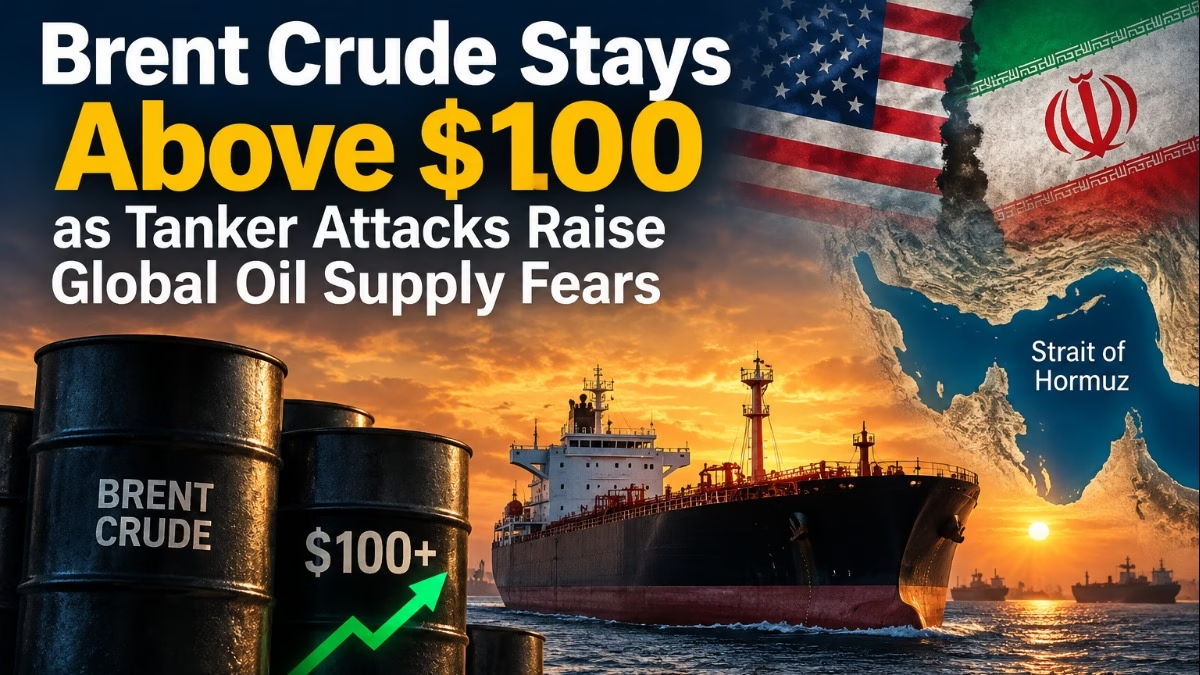
Brent Crude Stays Above $100 as Tanker Attacks Raise Global Oil Supply Fears
Oil prices are once again becoming a global economic concern. Brent crude is holding above $100 a barrel as renewed attacks on shipping involving the United States and Iran raise fears that oil supplies could face further disruption.
Brent crude was trading around $100.50 a barrel on September 10, even after slipping 0.7%. U.S. West Texas Intermediate was around $95.58.
The important point is not the small daily decline. It is that Brent has remained above the psychologically important $100 level as traders assess whether the latest attacks could turn into a much larger supply problem.
For consumers and businesses, that could eventually mean higher fuel, transportation and energy costs.
What Happened?
The latest escalation involves attacks on oil tankers and shipping around the Middle East.
According to Reuters, Iran said it attacked 10 ships near the Strait of Hormuz after the United States sank five Iranian oil tankers. Iran’s Islamic Revolutionary Guard Corps also warned that its response could escalate if further attacks occur.
U.S. President Donald Trump has meanwhile warned Iran against further escalation and indicated that the United States could target Iran’s Pickaxe Mountain.
The developments have increased uncertainty around one of the world’s most important oil-shipping regions.
Brent crude has risen nearly 30% from its early-August lows, reflecting the market’s growing geopolitical risk.
Why Does Brent Above $100 Matter?
Brent crude is one of the world’s most important oil price benchmarks. A sustained move above $100 can affect far more than energy traders.
Higher crude prices can eventually feed into:
- Petrol and diesel prices
- Airline operating costs
- Freight and transportation expenses
- Manufacturing costs
- Inflation
- Household energy bills
- Corporate profit margins
The effect is not always immediate. Oil companies, refiners and governments can absorb some of the increase temporarily.
But if crude remains above $100 for an extended period, the pressure becomes harder to contain.
That is why markets are watching the situation closely rather than focusing only on Thursday’s 0.7% decline.
The Strait of Hormuz Is the Critical Pressure Point
The biggest concern is the Strait of Hormuz, a narrow but strategically vital waterway connecting the Persian Gulf with the Gulf of Oman.
Before the conflict, roughly one-fifth of global oil and gas supplies moved through the strait.
Shipping traffic has already fallen well below normal levels.
That creates a problem even before physical oil production is seriously affected.
Oil can still exist underground or inside storage facilities. But if tankers cannot safely transport it to international buyers, the market can still experience a supply shortage.
This distinction is crucial.
The current oil-price risk is not simply about how much oil the world produces. It is also about whether that oil can move safely to where it is needed.
The Supply Problem Could Spread Beyond the Gulf
Another concern is the Red Sea.
Iran-aligned Houthi militants have reportedly increased attacks against Saudi Arabia, putting additional pressure on crude shipments through the Red Sea.
That means traders are not looking at a single shipping route in isolation.
If disruptions spread across multiple export routes, replacing lost supplies becomes considerably more difficult.
Alternative routes and pipelines may provide some relief, but they cannot necessarily compensate for a prolonged disruption involving such a strategically important region.
China Could Decide How High Oil Prices Go
There is another major factor that has received less attention outside energy markets: China’s crude oil demand.
China is the world’s largest crude oil importer.
According to ING analysts cited by Reuters, Chinese purchases have increased in recent weeks following months of relatively subdued demand.
That matters because stronger Chinese buying could magnify the effect of supply disruptions.
Think of it this way:
Less available oil + stronger demand = greater upward pressure on prices.
If Chinese imports continue recovering while Middle Eastern supply remains threatened, Brent could face additional upward pressure.
However, if Chinese demand weakens again, it could reduce some of the pressure on the oil market.
What Could Higher Oil Prices Mean for India?
India is particularly sensitive to international crude prices because it imports a large share of the oil it consumes.
A prolonged rise in crude prices can put pressure on India’s import bill and foreign-exchange requirements.
It can also create difficult choices for policymakers.
Higher oil prices can contribute to inflation, particularly through transportation and logistics costs. Those higher costs can eventually affect everything from manufactured goods to food distribution.
For Indian motorists, the most visible concern is fuel pricing.
But the broader impact can be much larger because petroleum products influence the cost of moving people and goods throughout the economy.
The Bigger Picture: This Is About Risk, Not Just Today’s Price
The most important message from the current oil market is that traders are pricing in risk.
The market does not need to lose millions of barrels of oil immediately for prices to rise.
It only needs to believe that future supplies could become harder to obtain or transport.
That is why geopolitical developments can produce sharp movements in crude prices even before an actual global shortage develops.
There is also an important psychological element.
Once traders begin expecting further disruptions, they may pay more for crude and related contracts as protection against future shortages.
That can reinforce the price increase.
What Happens Next?
Three developments will be particularly important to watch.
1. Will attacks on tankers continue?
If attacks remain limited, the oil market may eventually calm down.
If attacks intensify, traders could price in a much longer period of disruption.
2. Will shipping through Hormuz recover?
A sustained recovery in tanker traffic would reduce fears of a prolonged supply crisis.
Continued weakness would suggest that the market’s logistical problems are becoming more serious.
3. What will China do?
Chinese crude imports could become one of the most important demand-side signals.
Continued buying would add pressure to an already tight market. A significant slowdown could help limit further price increases.
Ravi Tiku’s Perspective
The headline number is $100 Brent, but the bigger story is what is happening behind that number.
Oil markets are effectively asking a simple question: Can the world’s major oil-exporting region continue supplying the global economy safely?
At present, there is no clear answer.
That uncertainty itself has value in the oil market, and traders are demanding a higher price to reflect it.
For ordinary consumers, this is also a reminder that geopolitical conflicts do not remain confined to distant borders. A disruption around a major shipping route can eventually affect fuel, transport, inflation and household expenses thousands of kilometres away.
At the same time, Brent staying above $100 does not automatically mean that petrol prices will immediately surge everywhere. Governments, refiners, currencies, inventories and local taxation all influence what consumers ultimately pay.
The real concern would be a prolonged period above $100, particularly if shipping disruptions worsen at the same time that Chinese demand strengthens.
Key Takeaway
Brent crude remaining above $100 is less about one day’s oil price and more about growing uncertainty over global supply routes.
The Strait of Hormuz remains the central risk. Additional attacks, prolonged shipping disruption and stronger Chinese oil demand could push prices higher.
For now, the market is watching the conflict, tanker movements and Chinese purchases closely.
The next major oil-price move may depend less on what happens to crude production today and more on whether the world can continue moving that crude safely tomorrow.
Source/Context:
This analysis is based on the Reuters report dated September 10, 2026, with interpretation added to explain the wider economic significance.
#BrentCrude #OilPrices #StraitOfHormuz #GlobalEconomy #EnergyMarkets