
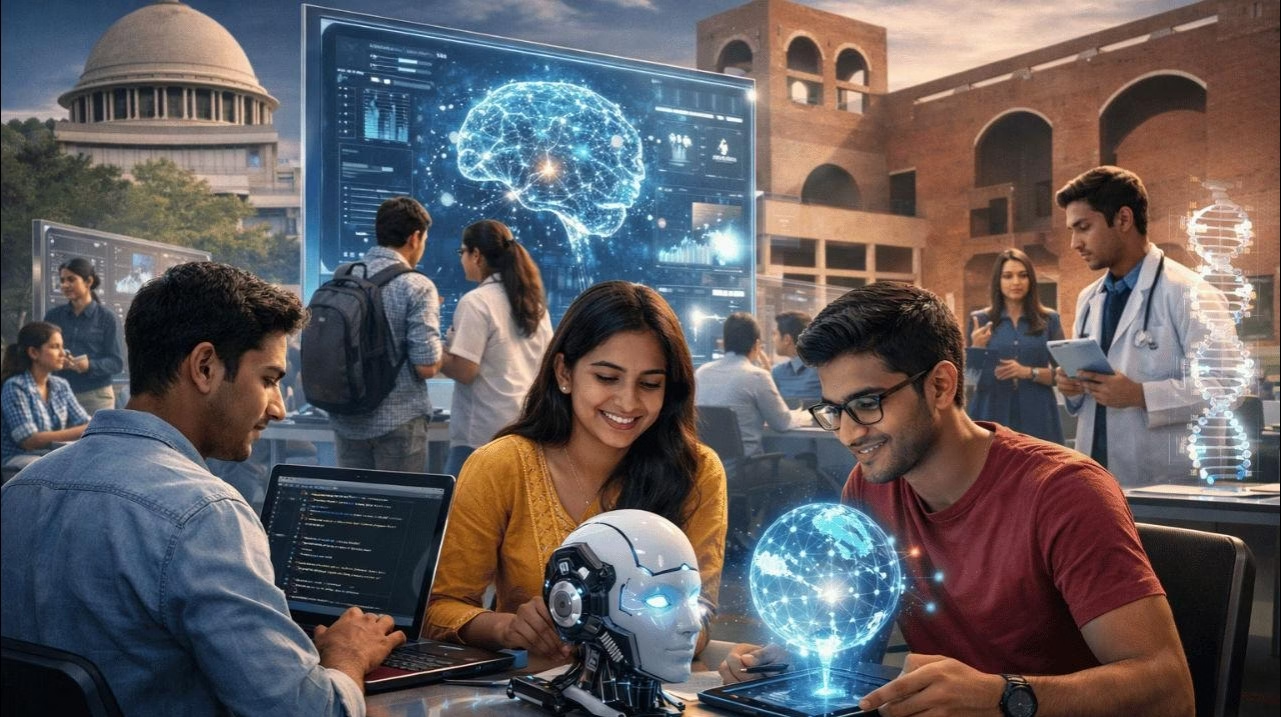
India’s Gen Z stands at a crossroads, facing jobs, education, economic pressure and the rapid rise of AI.
India’s Gen Z is growing up in a country full of possibilities, but also facing questions that previous generations rarely confronted at the same scale.
Education is more accessible. Information is available at the click of a button. Technology has opened new careers, entrepreneurship and global opportunities. Yet alongside this progress, a growing section of young Indians is asking a basic question: Will all this opportunity actually lead to a secure and meaningful future?
The concern is not only about jobs. It is about competitive examinations, fairness, economic pressure, rapidly changing careers and the arrival of artificial intelligence that could reshape the workplace before today’s students are ready for it.
This is why the restlessness among India’s youth deserves to be understood carefully. It is easy to label a generation impatient or rebellious. It is much more important to understand what is making them anxious, what they are asking for and whether the country is prepared to give them a fair chance.
This is not a story about a pessimistic generation.
It is a story about a generation demanding reasons to remain optimistic.
For many young Indians, the bigger questions are becoming uncomfortable: Where are the jobs? Will my education lead to a career? Will my effort be rewarded? And what happens when AI begins changing the very jobs I am preparing for?
These concerns help explain why youth frustration deserves to be understood rather than dismissed.
What Is Making India’s Gen Z Restless?
There is no single reason.
The restlessness comes from several pressures arriving at the same time: employment uncertainty, intense competition in education, concerns about examination systems, rising expectations, economic pressure and the rapid arrival of artificial intelligence.
For a generation that has grown up with instant access to information, waiting patiently for answers from institutions can be particularly difficult.
When young people believe that their future depends on a system working fairly, any allegation of examination irregularity or recruitment problems can become much more than a single incident.
It can become a question of trust.
Jobs Are at the Centre of the Anxiety
The first and most obvious concern is employment.
India has a huge young population entering the workforce every year. The challenge is not simply creating jobs. It is creating enough productive, reasonably secure and appropriately paid jobs for people with very different educational backgrounds.
A young person may spend years preparing for competitive examinations, professional courses or degrees. If suitable employment remains difficult to find afterward, frustration naturally follows.
This becomes even harder for young people from families with limited financial resources.
For an affluent family, an unsuccessful career attempt may mean trying again.
For a poorer household, another year of preparation can mean another year without income.
That difference matters.
When Examination Problems Become a Question of Trust
Competitive examinations have enormous importance in India.
For millions of students, an examination is not merely a test. It can represent years of sacrifice by the student and the family.
That is why allegations of paper leaks, irregularities or unfair examination practices can produce such strong reactions among young people.
When students believe that their opportunity has been compromised, the issue quickly moves beyond marks.
It becomes a question of fairness.
Recent youth-led agitation around examination-related concerns illustrates how quickly such issues can mobilise young people. Once students begin believing that their voices are not being heard, protests can become larger and more persistent.
The lesson for authorities is straightforward:
Young people need transparent answers, credible investigations and visible accountability when serious examination concerns arise.
Whether a particular allegation is ultimately proven is a matter for evidence and due process. But the loss of confidence itself is a serious issue.
Protest Is Also a New Form of Political Communication
Today’s young Indians communicate differently from previous generations.
A grievance can move from a classroom or local protest to social media within minutes.
A demonstration in one city can inspire discussion hundreds of kilometres away.
That does not mean every protest represents the views of India’s entire youth population. It does mean that young people now have unprecedented ability to organise, share information and make their concerns visible.
The recent examples of youth mobilisation in different parts of the country show why governments cannot treat young people’s concerns as isolated incidents.
The right response is neither to encourage disorder nor to dismiss legitimate concerns.
It is to listen, investigate and communicate clearly.
The Rise of Alternative Careers
There is another important side to this story.
India’s young people are not simply sitting and waiting for traditional employment.
Many are turning toward online education, freelancing, digital marketing, content creation, small businesses, technology services and other emerging fields.
This is encouraging.
The internet has reduced some of the traditional barriers to entering business.
A young person no longer necessarily needs a large office or substantial infrastructure to start something.
But there is a catch.
Digital opportunity can create headlines about spectacular success while hiding the much larger population struggling to earn a stable income.
One successful entrepreneur may inspire millions, but inspiration alone cannot replace a functioning employment ecosystem.
India needs both.
Entrepreneurship can create opportunities, but traditional employment will remain essential for millions of young people.
The Sports Economy Creates Another Contradiction
Sports offers another fascinating example.
Cricket, particularly the IPL ecosystem, has demonstrated how enormously valuable sporting talent can become.
Large financial rewards are possible for those who reach the top.
That creates aspiration, which is not necessarily a bad thing.
But it can also create distorted expectations.
Only a small proportion of aspiring athletes reach elite professional levels. Many talented young sportspeople still struggle for adequate facilities, coaching, competition opportunities and financial support.
The lesson should not be that successful sportspeople earn too much.
The real question is whether India is creating enough pathways for talented young people in different sports to develop their abilities.
A country cannot build a sporting culture simply by celebrating the few who reach the top.
It must invest in the many who are still climbing.
Then Comes the Biggest Disruption of All: AI
If employment uncertainty is today’s problem, artificial intelligence could become tomorrow’s defining challenge.
AI can already assist with writing, coding, research, design, analysis, customer service and countless other tasks.
For young people entering the workforce, this creates a difficult psychological question:
If machines can perform part of the work I have spent years learning, what exactly should I prepare for?
That question should not lead to fear.
It should lead to a change in education.
Young Indians need to learn how to work with AI rather than simply compete against it.
The most valuable skills of the future are unlikely to be limited to memorising information.
Critical thinking, communication, creativity, leadership, judgment, problem-solving and the ability to understand people will remain important.
AI can provide information.
Human beings still have to decide what that information means and what should be done with it.
The Warning Signs From Inside the AI Industry
There is another reason young people may feel uncertain.
Even some highly experienced technology researchers have publicly raised concerns about the direction and speed of AI development.
Those warnings should neither be ignored nor exaggerated.
AI is neither automatically humanity’s saviour nor automatically its destroyer.
The important issue is how society chooses to develop and deploy it.
That means governments, companies, educators and technology leaders have a responsibility to establish sensible safeguards while ensuring that young people receive the skills needed to benefit from the technology.
India cannot afford an approach in which AI arrives first and workforce preparation follows years later.
How Different This Is From the 1990s
This is perhaps where the generational difference becomes most striking.
For many young people in the 1990s, the pathway appeared relatively straightforward.
Study.
Work hard.
Complete your education.
Find a job.
Build a career.
The competition was real, but the information environment was very different.
Today’s young person lives in a world of constant comparison.
Success is displayed everywhere.
A student can watch a 20-year-old entrepreneur become successful on social media, see a sports star earn enormous sums, watch an influencer build a business and simultaneously hear about automation eliminating traditional jobs.
This creates enormous psychological pressure.
The young person is not simply competing with classmates anymore.
They feel they are competing with the entire world.
Ravi Tiku’s Perspective
I believe we should be careful before describing India’s Gen Z as simply restless, impatient or rebellious.
There is another way of looking at it.
Perhaps they are asking a very reasonable question:
“If we work hard, study honestly and develop our skills, will the system give us a fair opportunity?”
That question deserves a serious answer.
I grew up in a period when our principal concern was largely to focus on education, build our knowledge and enter a professional field through our own effort.
The environment today is fundamentally different.
Information is everywhere.
Competition is global.
Technology is changing rapidly.
And artificial intelligence is beginning to challenge traditional definitions of work and creativity.
But I do not believe India’s youth should become pessimistic.
Quite the opposite.
India’s young population can become one of the country’s greatest strengths if the right environment is created around it.
The responsibility therefore cannot rest entirely on young people.
They must acquire skills, remain adaptable and take responsibility for their choices.
But institutions also have responsibilities.
Examinations must be trustworthy.
Recruitment processes must be transparent.
Skill development must match the real economy.
Entrepreneurship must receive practical support.
And AI must be introduced in a way that expands human capability rather than simply reducing the value of human workers.
Most importantly, young Indians need hope backed by opportunity, not hope offered merely as a slogan.
What Should India Do Now?
The answer is not to promise every young person a government job.
That is neither realistic nor sustainable.
The bigger task is to build an economy in which young people can find multiple pathways to a dignified livelihood.
That means:
- Creating more productive employment opportunities.
- Improving the credibility and transparency of competitive examinations.
- Expanding practical vocational and digital skills.
- Supporting genuine small businesses and entrepreneurs.
- Developing stronger pathways for sports and other talent.
- Preparing students for AI-enabled workplaces.
- Teaching critical thinking alongside technical skills.
- Communicating honestly with young people when problems occur.
Most importantly, the country needs to restore the connection between effort and opportunity.
When young people believe that honest effort can improve their future, societies become more stable and optimistic.
When they begin believing that effort does not matter, frustration grows.
What Happens Next?
India’s youth story will depend heavily on how the country manages this transition.
The coming years will bring more automation, more competition and probably more disruption to traditional careers.
But they can also bring new industries, new businesses and entirely new forms of employment.
The choice is not between protecting young people from change and forcing them to accept it.
The real challenge is preparing them to benefit from change.
That requires cooperation between government, educational institutions, employers, technology companies and young people themselves.
Key Takeaway
India’s Gen Z does not need pessimism.
It needs confidence that effort still has value.
The country’s young people are entering adulthood at a remarkable moment. They have access to technology and information that previous generations could never have imagined.
But opportunity must be matched by fairness.
If India can create credible examinations, meaningful employment, better skills, entrepreneurial opportunities and responsible AI adoption, today’s restlessness can become tomorrow’s energy.
The greatest danger is not that India’s youth are asking too many questions.
The greater danger would be if they stopped believing that their questions mattered.
India’s future will ultimately be shaped by the confidence, skills and opportunities given to the generation that will inherit it.
#GenZIndia #IndianYouth #YouthEmployment #ArtificialIntelligence #RavisPerspective