
Trump’s $5,000 Promise: Election Strategy or Economic Relief?
President Donald Trump has put a striking new proposal at the center of the 2026 US midterm election debate: a $5,000 payment to every adult American if Republicans win control of both chambers of Congress.
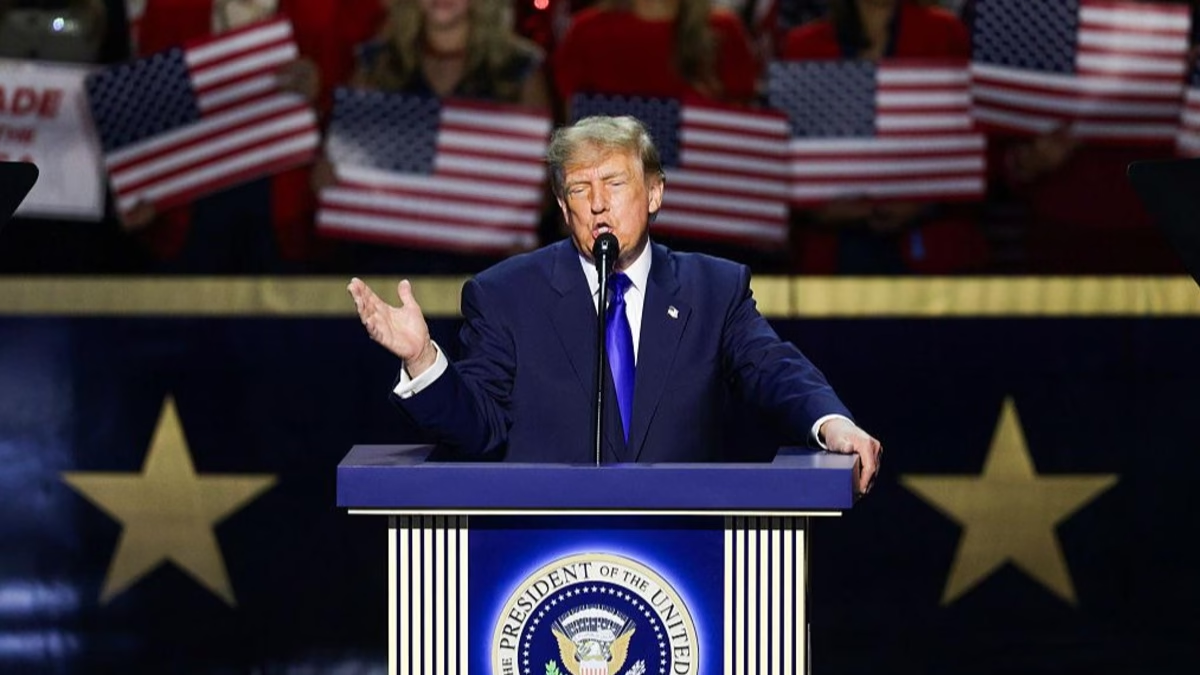
Trump made the promise while addressing Republicans at the party’s first-ever convention held during the middle of a presidential term. He described the payment as a “dividend” and said Americans should spend the money inside the United States.
At first glance, the proposal sounds simple: Republicans win the House and Senate, and American adults receive $5,000.
The reality is far more complicated.
The size of the proposed payment, the source of the money, Congress’s role, the legal questions and the condition of the US economy all raise important questions. For ordinary Americans, the headline figure matters less than whether such a payment could actually become government policy.
What Did Trump Promise?
Trump said that if Republicans win both the House of Representatives and the Senate in November’s midterm elections, he would issue a $5,000 dividend to every adult citizen.
He did not provide a detailed plan explaining:
- How the payments would be funded
- Whether Congress would approve the spending
- When Americans would receive the money
- Whether every adult would qualify regardless of income
- How the government would enforce his request that the money be spent in America
The scale of the proposal is enormous.
There are nearly 270 million adults in the United States. A $5,000 payment for each would therefore cost roughly $1.3 trillion.
That makes the funding question central to the entire proposal.
Why Does the $5,000 Figure Matter?
A $5,000 payment would be significant for many American households, particularly at a time when consumers are dealing with higher prices and uncertainty over energy costs.
But the government’s cost would also be substantial.
The federal government would need to identify a funding mechanism capable of supporting a payment approaching $1.3 trillion. That could involve government revenues, spending reductions, borrowing, tax changes or another mechanism.
Trump did not explain the financing during his speech.
That is why the proposal should currently be viewed as an electoral promise rather than an established government programme.
The difference is important. A presidential statement alone does not create a federal payment. Congress plays a major role in authorising federal spending.
How Does the Iran War Enter the Picture?
The timing of the proposal is particularly important.
The United States and Israel’s conflict with Iran has contributed to pressure on energy markets. Iranian retaliation has included attacks against US bases and regional allies, while the disruption around the Strait of Hormuz has affected the movement of oil and liquefied natural gas.
The Strait is strategically important because a large share of global energy supplies normally passes through it.
Disruption has contributed to volatility in oil prices, adding another challenge for American consumers.
Trump has acknowledged that the economic pain could continue. He has also told supporters that the war would not end until after the midterm elections and that oil prices would not fall until then.
This creates an unusual political backdrop for his $5,000 proposal.
On one side, voters are facing pressure from energy and other living costs. On the other, Trump is promising a large financial benefit if Republicans retain or strengthen their control of Congress.
Could the Payment Actually Happen?
That remains uncertain.
The biggest immediate obstacle is not whether the federal government can technically distribute money. It is whether the necessary legislation could pass and how the government would pay for it.
Congress controls federal spending. Therefore, a nationwide payment of this size would require a substantial legislative and budgetary process.
There is also a legal question.
US federal law restricts certain payments or benefits intended to influence voting. That raises questions about whether linking a proposed payment directly to an election result could create legal difficulties.
However, legal experts have offered a different interpretation. The proposal could potentially be framed as a tax-related measure rather than a direct payment designed to influence voters. Constitutional free-speech protections could also become relevant.
The legal status of the proposal therefore cannot be determined simply from Trump’s speech.
Trump Has Made Similar Proposals Before
This is not the first time Trump has proposed putting money directly into Americans’ hands.
He has previously discussed $2,000 payments funded by tariff revenues.
The latest proposal follows a similar political logic: use government-generated revenue to provide Americans with a direct financial benefit.
The difference is the scale.
A $5,000 payment to nearly 270 million adults would represent an extraordinary fiscal commitment. That makes the source of funding much more important than the headline promise itself.
What Could It Mean for the US Economy?
The economic impact would depend heavily on how the payment was financed.
If the government funded the programme through existing revenue, the effect could differ substantially from a programme financed through additional borrowing.
A large cash injection could increase consumer spending. That might help retailers and other businesses in the short term.
But if the economy were already experiencing strong price pressures, additional spending could also create concerns about inflation.
There is another important issue: Americans might not actually receive the full economic benefit suggested by the $5,000 headline if the government had to raise taxes, reduce other spending or increase borrowing to finance it.
In other words, where the money comes from matters just as much as how much money Americans receive.
What Could It Mean Politically?
This may be the most important part of Trump’s proposal.
Midterm elections often become a referendum on economic conditions and the performance of the party in power.
A direct $5,000 promise gives Republicans a simple message to take to voters: support the party and potentially receive a substantial financial benefit.
That could resonate with voters struggling with household expenses.
But voters may also ask a different question:
Can the government realistically afford it?
The answer could influence how the proposal is received.
If Americans see the payment as financially credible, it could become a powerful campaign message. If they view it as an unrealistic promise without a clear funding plan, it could instead become a target for political criticism.
Democrats have already dismissed the proposal as an “empty promise.”
What Should Americans Watch Next?
The most important developments will not be another campaign speech. They will be the details.
Watch for these questions:
- Where would the $1.3 trillion come from?
- Would Congress formally support the proposal?
- Who would qualify for the payment?
- Would there be an income limit?
- When would payments be distributed?
- How would the government legally structure the programme?
- Would the proposal become part of the Republican midterm campaign platform?
Until these questions receive credible answers, the $5,000 figure should not be treated as money Americans are certain to receive.
Ravi Tiku’s Perspective
The most revealing part of this story may not be the $5,000 number itself.
It is the political connection between economic pressure and electoral choice.
When household costs rise, voters naturally pay greater attention to anything that could improve their finances. A direct payment is easy to understand and easy to communicate during an election campaign.
But government economics is rarely that simple.
A $5,000 payment could provide immediate relief to millions of Americans. Yet the government would still have to account for every dollar used to finance it.
That is why voters should look beyond the promise and ask three basic questions:
Who pays? How is it funded? And what are the consequences afterward?
Those questions matter more than the size of the cheque.
There is also a broader political lesson. Economic promises become particularly powerful when voters are worried about their standard of living. The 2026 midterms could therefore become not only a contest over congressional control, but also a referendum on how Americans believe the government should respond to rising economic pressures.
What Happens Next?
The next stage will be the political and legislative debate over whether the proposal is financially and legally workable.
The November midterm elections will determine the balance of power in Congress. If Republicans win control of both chambers, pressure will increase to explain exactly how Trump’s proposed dividend would be implemented.
Until then, the proposal remains a campaign promise rather than an approved federal benefit.
Key Takeaway
Trump’s proposed $5,000 payment to American adults is a politically powerful idea, but the headline leaves several major questions unanswered.
The potential cost could reach about $1.3 trillion, and Congress would have an important role in any federal spending programme of this scale.
For American voters, the key issue is therefore not simply whether $5,000 sounds attractive.
It is whether the government can realistically fund it, legally implement it and deliver it without creating larger economic problems later.
The news tells you what Trump promised. The bigger question is whether the numbers, the law and Congress can make that promise real.
#DonaldTrump #USMidterms2026 #USPolitics #AmericanEconomy #TrumpDividend