
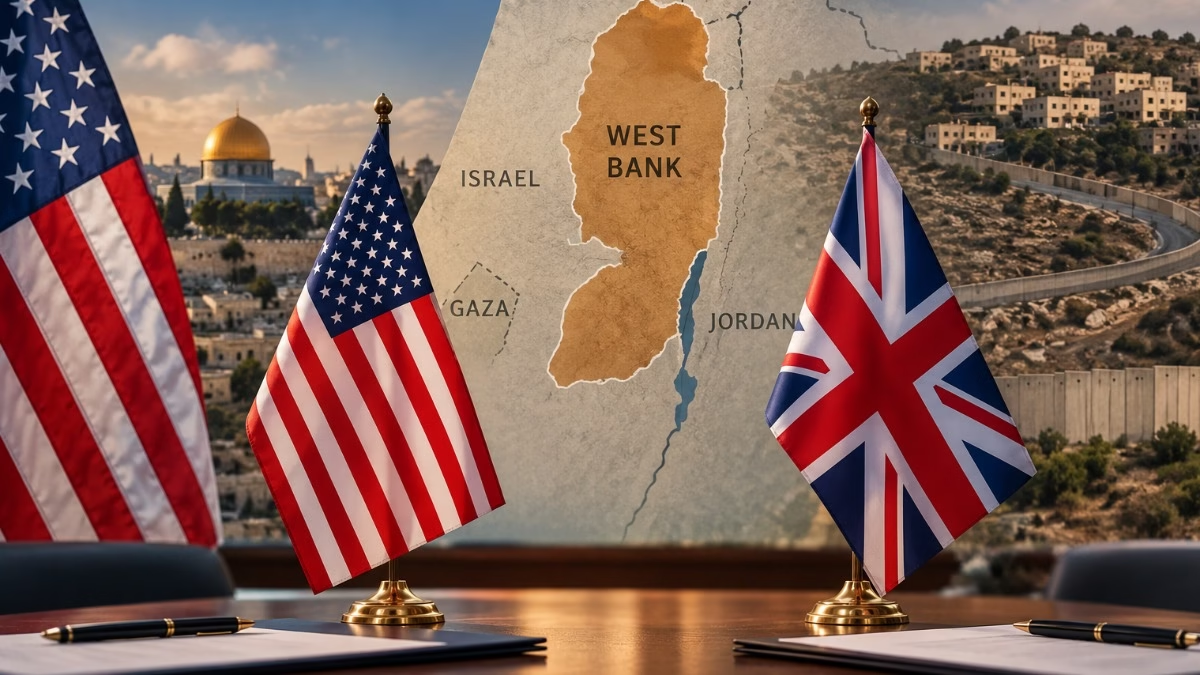
US and UK flags frame the West Bank as Washington takes a cautious approach to Britain’s sanctions on Israeli settlements.
The UK’s decision to restrict trade in goods from Israeli settlements in the occupied West Bank has triggered a sharp response from Israel. But the more significant development may be Washington’s reaction.
Instead of immediately condemning Britain or threatening retaliation, the Trump administration has so far responded cautiously. That restraint could signal growing frustration in Washington over Israel’s settlement policy and the wider direction of the Middle East conflict.
The news, therefore, is not just about Britain’s sanctions. It is about a potentially changing relationship between Israel, its Western allies and the United States.
What Happened?
Britain has moved to restrict trade in goods produced in Israeli settlements in the West Bank, arguing that settlement expansion and settler violence are undermining the possibility of a future two-state solution.
The UK is not acting alone. France and Canada have announced similar measures, while several other countries have said they are considering restrictions. Twelve countries have backed coordinated action over settlement expansion.
Israel responded strongly.
It announced plans to close Britain’s consulate in East Jerusalem, exclude Britain from aspects of a US-led Gaza coordination mission and restrict entry for some British nationals.
That turned a trade dispute into a wider diplomatic confrontation.
Why Does the US Response Matter?
For decades, Israel has generally been able to rely on strong American diplomatic support when disagreements with European governments intensified.
This time, Washington has not immediately taken Britain’s side — but neither has it launched a major attack on London.
That distinction matters.
The United States has made clear that it will not copy Britain’s policy. At the same time, its response has been far less confrontational than some expected.
Washington may be trying to avoid opening another diplomatic front while it deals with much larger Middle East challenges.
The Bigger Picture
The West Bank has become an increasingly difficult issue for Israel’s traditional allies.
Governments supporting a two-state solution argue that continued settlement expansion could make the creation of a viable Palestinian state increasingly difficult.
The E1 settlement project is particularly sensitive because its development could divide parts of the West Bank and further complicate Palestinian territorial continuity. More than 20 governments have previously warned that the project threatens the two-state solution
The issue is therefore moving beyond political statements.
Some governments are now prepared to attach economic consequences to settlement activity.
That represents a significant diplomatic shift.
Why Washington May Be Holding Back
There are several possible reasons.
First, the Trump administration has broader strategic priorities in the Middle East. The United States is dealing with the continuing confrontation with Iran and wider regional instability.
Second, Washington needs cooperation from Arab governments on issues involving Gaza and regional security.
Third, the administration may not want a dispute with Britain to become another major transatlantic confrontation.
There is also evidence that Washington itself is increasingly concerned about settler violence. US Ambassador to Israel Mike Huckabee recently condemned violent settlers during a visit to a Palestinian town in the West Bank.
Israel has also reportedly faced US pressure over settler violence, with Prime Minister Benjamin Netanyahu ordering the removal of some unauthorized outposts.
This does not mean that Washington is abandoning Israel.
It suggests that American support may come with more conditions and more disagreement over specific policies.
What Happens Next?
Three developments are worth watching.
First, will more countries impose trade restrictions?
If additional governments follow Britain, France and Canada, the economic impact may remain limited but the diplomatic pressure will grow.
Second, will Israel expand its retaliation?
Israel has already responded strongly to Britain’s decision. Further diplomatic measures could widen the dispute.
Third, will Washington eventually take a stronger position?
The current US response is cautious. That could change if settlement expansion or violence becomes a larger obstacle to American regional diplomacy.
Ravi Tiku’s Perspective
The most important part of this story may not be Britain’s decision.
It is America’s restraint.
The United States remains Israel’s most important strategic partner. But Washington also needs European cooperation and working relationships with Arab governments.
That creates a difficult calculation.
Defending Israel is one thing. Defending every Israeli government policy is another.
For now, Washington appears to be drawing that distinction.
The message may be subtle, but it matters: America can remain firmly allied with Israel while becoming less willing to automatically defend every Israeli policy on the international stage.
If that approach continues, settlement expansion could become a more significant point of friction between Washington and Jerusalem.
Key Takeaway
Britain’s sanctions alone are unlikely to transform the Israeli-Palestinian conflict.
Their larger importance is diplomatic.
Several Western governments are moving from criticism to practical measures over Israeli settlement activity, while Israel is responding forcefully.
But the biggest question remains Washington.
If the United States continues to resist automatically shielding Israel from criticism over settlements and settler violence, the diplomatic landscape around Israel could gradually change.
The real story, therefore, is not simply that Britain sanctioned settlement goods. It is that Israel’s traditional allies are becoming more willing to act — while Washington appears increasingly selective about when it will step in.
Source/Context: This article draws on current Reuters reporting and official UK government statements concerning settlement trade restrictions, the Israeli response and the wider two-state debate
#WestBank #Israel #USForeignPolicy #MiddleEast #Geopolitics