
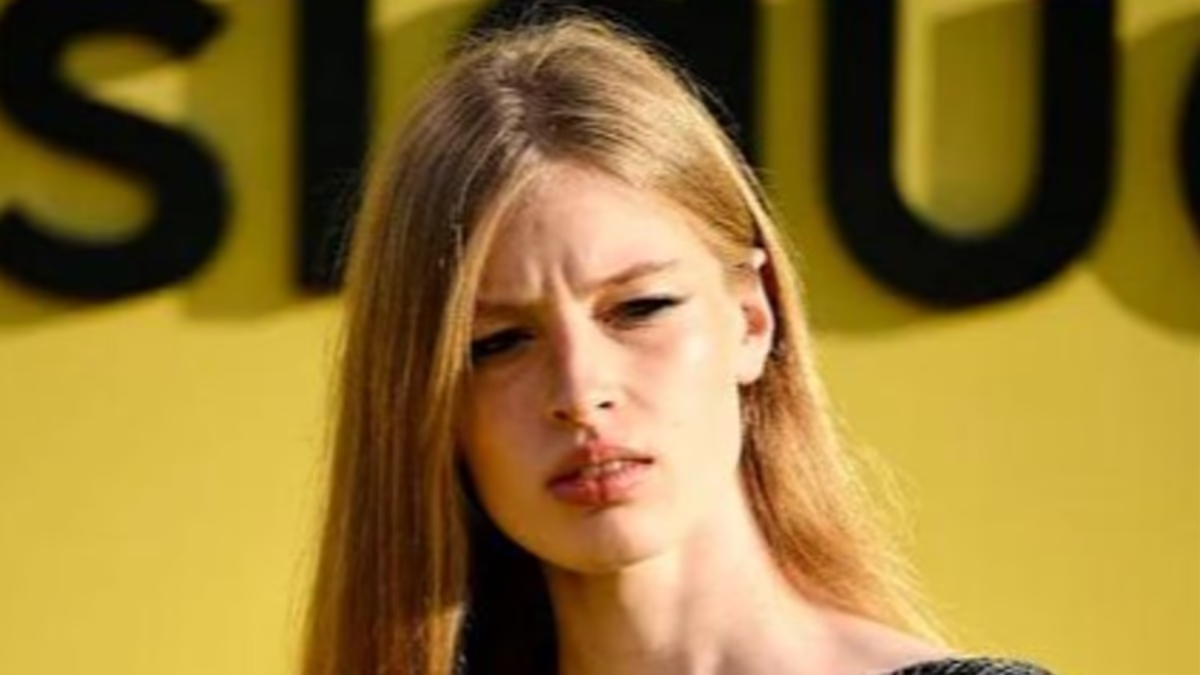
Vivian Wilson stars in Desigual’s “Born to Disobey” campaign, which challenges the growing influence of AI and celebrates human individuality.
Artificial intelligence is rapidly moving into fashion, entertainment and everyday life. But not everyone is celebrating that transformation.
Transgender model and activist Vivian Wilson, the estranged daughter of technology billionaire Elon Musk, has become the face of Desigual’s fall 2026 campaign, “Born to Disobey.” The campaign takes a playful but pointed swipe at artificial intelligence and robotics.
At first glance, it is simply a fashion advertisement. Look closer, however, and the campaign touches on a much larger debate: What happens when technology tries to replace human creativity, identity and judgment?
That question gives Wilson’s appearance in the campaign a significance beyond fashion.
What Happened?
Spanish fashion label Desigual has launched its fall 2026 “Born to Disobey” campaign featuring Vivian Wilson.
The campaign places Wilson alongside a malfunctioning robot called DESI84. The robot struggles with basic tasks and repeatedly fails to perform as expected.
In one sequence, the robot is used as a golf tee. In another, Wilson walks it like a dog. The machine also fails when asked to say “Desigual” and eventually ends up repeatedly hitting its head against a wall.
The campaign concludes with Wilson delivering its central message:
“Some things aren’t meant to be fixed.”
Wilson also appears wearing Desigual clothing, including a “Born to Disobey” T-shirt.
The brand presents the campaign as an expression of independence and rebellion against conformity. Its message is that creativity and individuality do not necessarily need to follow the logic of machines.
Why Does This Campaign Matter?
The advertisement arrives at an interesting moment for artificial intelligence.
AI is increasingly being used to generate images, write content, produce advertising material and assist creative professionals. At the same time, many artists, writers, actors and other creators are questioning how much of human creativity should be handed over to machines.
Desigual’s campaign turns that discussion into a piece of popular culture.
Rather than presenting AI as an unstoppable technological achievement, the advertisement uses humor to highlight its limitations.
The underlying question is simple:
Can technology reproduce human creativity without losing something important along the way?
There is no simple answer. AI can perform tasks remarkably quickly, but creativity also involves personal experience, emotion, cultural understanding and intentional imperfection.
That distinction is becoming increasingly important as AI enters creative industries.
The Elon Musk Connection Adds Another Layer
The campaign has attracted additional attention because of Wilson’s relationship with Elon Musk.
The advertisement does not name Musk. However, the contrast is difficult to overlook.
Musk has invested heavily in artificial intelligence and robotics through his broader technology interests, including xAI and its Grok platform, while Tesla has also pursued robotics and autonomous technology.
Wilson, meanwhile, is publicly positioning herself in a campaign that challenges the idea of blindly embracing machines.
That does not necessarily mean the advertisement is officially a direct attack on Musk. The campaign’s message belongs to Desigual, and Wilson’s comments should be understood within that creative context.
Still, the timing and symbolism are likely to encourage audiences to make their own connection.
Vivian Wilson’s Public Identity Makes the Campaign More Significant
Wilson’s participation also carries personal significance because of her highly publicized relationship with her father.
Musk has repeatedly spoken publicly about Wilson and has continued to refer to her by her former name and as his son. He has also made controversial comments about her transition.
Wilson has publicly rejected that characterization of her identity.
That history means the phrase “Born to Disobey” carries an additional resonance when Wilson is the person delivering the campaign’s message.
Again, it would be too simplistic to describe the entire advertisement as a personal dispute between father and daughter. The campaign is fundamentally a fashion project.
But Wilson’s public history inevitably influences how audiences interpret her appearance.
The Bigger Picture: AI Is Becoming a Cultural Question
The debate over artificial intelligence is no longer limited to technology companies and computer scientists.
It has entered fashion, entertainment, journalism, education and advertising.
That shift matters because AI raises questions that cannot be answered simply by asking whether a machine works.
Businesses also have to consider whether customers want human creativity or machine-generated alternatives.
Creators have to consider how they can protect their work while using new technology.
Consumers have to decide whether speed and convenience are more important than authenticity.
And brands increasingly have to decide what position they want to take in this debate.
Desigual appears to be choosing rebellion.
Its campaign suggests that imperfections may sometimes be more valuable than technological perfection.
What Could This Mean for Fashion and Advertising?
The campaign reflects a broader trend in advertising: brands are increasingly using cultural debates to define their identity.
Instead of simply showing clothes, companies want campaigns to communicate an attitude.
“Born to Disobey” does exactly that.
The clothing becomes part of a larger message about independence, individuality and resistance to conformity.
That strategy can make a campaign more memorable, but it also carries risks. When a brand enters a controversial cultural conversation, audiences may focus more on the message than the product.
In Wilson’s case, that conversation is almost certain to extend beyond fashion.
What Happens Next?
The larger question is whether anti-AI messaging will become a recurring theme in creative industries.
AI adoption is unlikely to stop because of criticism. The more realistic debate will probably be about where humans should remain in control and where machines can provide useful assistance.
Fashion may become one of the places where that argument is expressed most visibly.
Consumers could increasingly see campaigns that emphasize human craftsmanship, individuality and imperfections as a counterpoint to AI-generated content.
The real competition may not be humans versus machines.
It may be about deciding how much of each we want in the creative world.
Ravi Tiku’s Perspective
The interesting part of Vivian Wilson’s Desigual campaign is not simply that she is criticizing AI.
The deeper message is about human individuality.
Technology is designed to make processes faster, more efficient and more predictable. Human beings, however, are often valuable precisely because they are unpredictable.
A machine can reproduce an image. It can generate words. It can analyze enormous amounts of information.
But culture is not created only by efficiency.
Fashion, art, writing and music often gain their meaning from the personality and experiences behind them.
That is why the campaign’s central line, “Some things aren’t meant to be fixed,” works beyond the robot joke.
Perhaps not every human imperfection is a problem waiting for technology to solve.
Key Takeaway
Vivian Wilson’s appearance in Desigual’s “Born to Disobey” campaign is more than a fashion endorsement.
It uses a malfunctioning robot to question the growing influence of artificial intelligence while celebrating individuality and human expression.
The campaign also attracts extra attention because of Wilson’s complicated public relationship with Elon Musk, one of the world’s most prominent technology entrepreneurs and AI advocates.
Whether viewers see the advertisement as clever marketing, cultural commentary or a subtle personal message, it reflects a debate that is becoming increasingly difficult to ignore:
As machines become more capable, preserving what makes human creativity distinctive may become even more important.
#VivianWilson #ArtificialIntelligence #Desigual #ElonMusk #AIFashion